physics · February 27, 2024
Real Good Physics: The Brilliance of ER=EPR
In the realm of theoretical physics, groundbreaking ideas often arrive like comets—dazzling, rare, and capable of changing the course of humanity. One such paradigm-shifting concept is the ER=EPR conjecture, proposed by Juan Maldacena and Leonard Susskind.
 Published by Matt
So P = 1?
No! The "equation" originates from the initial letters of the last names of the scientists who authored the pioneering papers on wormholes (Albert Einstein and Nathan Rosen) and on entanglement (Einstein, Boris Podolsky, and Rosen). These foundational papers were both released in 1935. However, it's important to note that the original authors did not assert any direct linkage between these two concepts at that time. Enter ER=EPR: This elegant yet profound idea bridged these two seemingly unrelated domains of theoretical physics and not only captured the imagination of physicists worldwide but also offered a novel perspective on the fabric of reality itself.
The Magic of ER=EPR
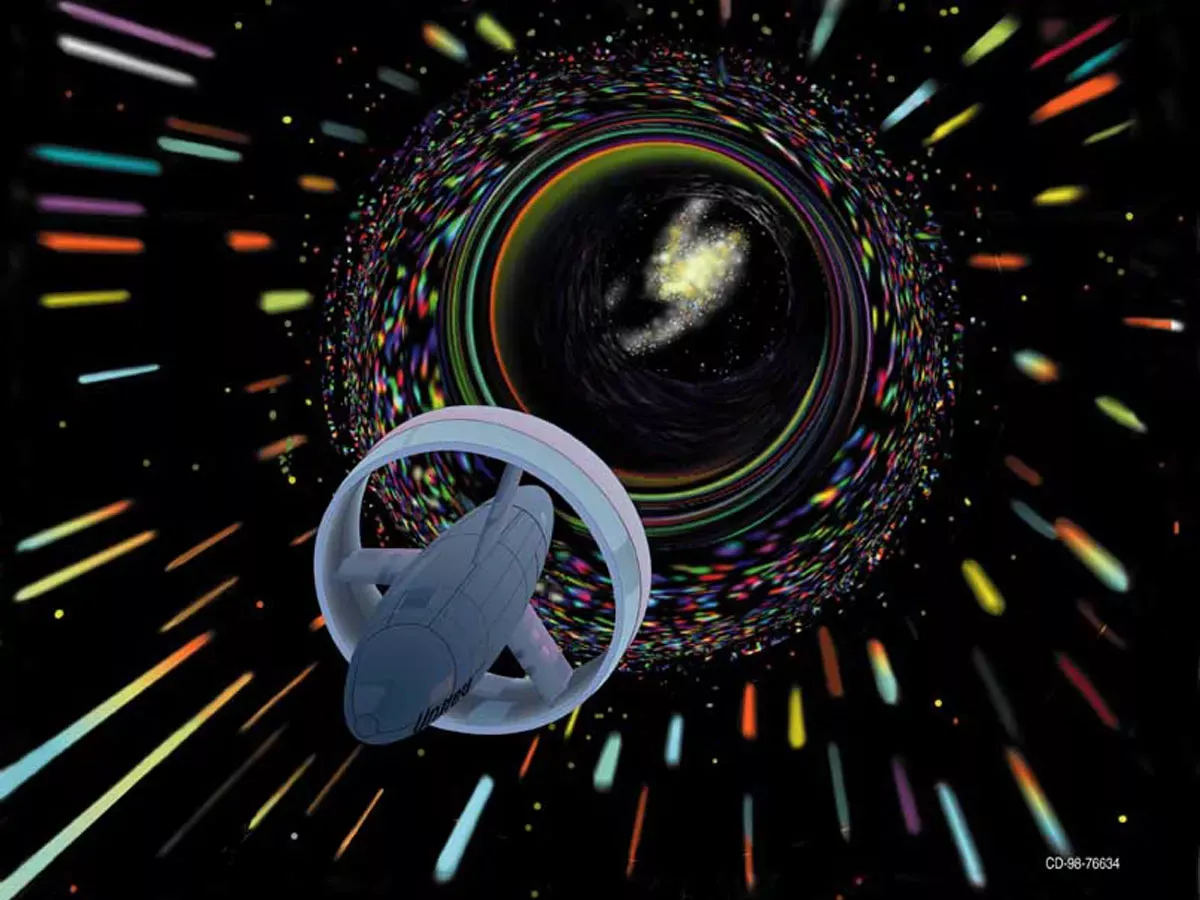
At its core, ER=EPR suggests a deep, underlying connection between the geometry of spacetime, embodied by wormholes, and the fundamental quantum mechanical property of entanglement. Wormholes, as theorized in general relativity, are shortcuts through spacetime, connecting distant points in the universe. On the other hand, quantum entanglement is a peculiar bond between particles where the state of one instantaneously influences the state of another, regardless of the distance separating them.
Why ER=EPR Is Revolutionary
The brilliance of ER=EPR lies in its audacious claim that these two phenomena are not just analogous but actually equivalent:
Unifying Gravity and Quantum Mechanics: The ER=EPR conjecture provided a tantalizing hint towards a theory of quantum gravity, a long-sought goal in physics. By linking the geometric, spacetime-centric view of general relativity with the probabilistic, non-local world of quantum mechanics, ER=EPR offers a potential pathway to reconcile the two pillars of modern physics.
Solving the Black Hole Information Paradox: Black holes, with their immense gravity preventing even light from escaping, pose a significant puzzle: do they destroy information, violating quantum mechanics' tenet that information is conserved? ER=EPR suggests that entangled particles outside the black hole could be connected via a wormhole to particles inside, implying that information is not lost but rather, it's hidden in the fabric of spacetime, offering a novel solution to the paradox.
A New Vision of Spacetime: Perhaps most profoundly, ER=EPR alters our conception of the universe's fabric. If entanglement and spacetime geometry are indeed equivalent, then the universe at a fundamental level could be stitched together by a vast network of entanglements, suggesting a spacetime emerging from quantum entanglement itself.
The Math is Epic: The true genius of ER=EPR extends into the realm of mathematical physics, particularly through its relationship with holographic principles, a concept that is as profound as it is revolutionary. This connection brings to light the intricate tapestry that weaves together the very fabric of our universe, grounding the conjecture in a mathematically rigorous framework that dazzles the scientific community.
Holographic Principle: At the heart of the ER=EPR conjecture's mathematical elegance is its interplay with the holographic principle. This principle suggests that the information contained within a volume of space can be represented as a hologram—a two-dimensional surface that encodes the three-dimensional phenomena within. This radical idea, which originally emerged from the study of black holes, posits that our three-dimensional reality might fundamentally be encoded on a two-dimensional boundary.
Holographic Equivalence: The holographic principle underpins the concept of holographic equivalence, where phenomena in a gravity-bound, higher-dimensional space can be equivalently described by a quantum field theory on its lower-dimensional boundary. This equivalence is not merely a theoretical curiosity; it provides a powerful computational tool for exploring quantum gravity and strongly interacting quantum systems, where traditional methods falter.
ER=EPR and Holography: The ER=EPR conjecture enriches this framework by suggesting that wormholes (ER bridges) and quantum entanglement (EPR pairs) are two sides of the same coin, potentially serving as the cosmic glue that holds the universe's holographic tapestry together. This notion hints at a universe where spacetime itself emerges from entanglement, as encoded on a holographic boundary. Such a universe is not just connected by the entanglement of particles across vast distances but fundamentally constituted by these entangled relationships, weaving a spacetime that is holographically emergent from quantum information.
The Impact and Beyond
Since its introduction, ER=EPR has sparked a flurry of research and debate, pushing the boundaries of theoretical physics:
Inspiring New Research: From attempts to mathematically formalize the conjecture to experimental proposals for observing analogues of ER=EPR in the lab, the conjecture has energized the theoretical physics community.
Philosophical Implications: Beyond the technical, ER=EPR has philosophical implications about the nature of reality, information, and causality, fostering interdisciplinary discussions that reach into the realms of philosophy and information theory.
A New Framework for Quantum Mechanics and General Relativity: By providing a conceptual framework that interlinks the macroscopic and microscopic worlds, ER=EPR serves as a beacon for future theories that aim to unify the forces of nature.
Challenges and Future Directions
Like all groundbreaking theories, ER=EPR faces challenges. The precise mathematical underpinnings and physical implications of the conjecture are areas of ongoing research and debate. Key questions about the nature of wormholes, the specifics of quantum entanglement, and how these might be experimentally verified remain open.
Conclusion
ER=EPR is more than a conjecture; it's a visionary leap that has reshaped our understanding of the universe. By proposing a fundamental link between the geometry of spacetime and quantum entanglement, it offers a glimpse into a universe more interconnected and mysterious than we ever imagined. As research into ER=EPR continues, we stand on the brink of potentially transformative discoveries that could unlock the secrets of quantum gravity and beyond. In the quest to understand the cosmos, ER=EPR is a testament to the power of theoretical physics to illuminate the mysteries of the universe, reminding us that in the vast, intricate dance of the cosmos, everything is connected.